The textile industry in India is one of the largest and most important sectors in the country. Tamil Nadu alone is home to thousands of spinning mills, weaving units, and processing factories. Yet despite this massive scale, many mills continue to face the same problems every single day — dusty machines, cluttered floors, frustrated workers, and quality issues that nobody can quite explain.
The answer to most of these problems is simpler than you think. 5S implementation in the textile industry is a proven, practical workplace management method that has transformed factories across Asia, and it is now helping spinning mills and textile units across India work smarter, cleaner, and more efficiently.
What Exactly Is 5S?
5S is a structured workplace management method that was developed in Japan. It is built on five simple steps. Each step starts with the letter S, which is why the method is called 5S.
The five steps are:
Sort — Remove everything from the work area that is not needed.
Set in Order — Give every item a fixed, logical place.
Shine — Clean machines, floors, and workstations regularly.
Standardize — Create simple visual rules so everyone knows what correct looks like.
Sustain — Build the daily habit of following the first four steps.
That is it. Five steps. But when these five steps are applied properly, they create a workplace that runs better, feels better, and produces better results. 5S implementation in the textile industry is not complicated — it is disciplined. And discipline, applied consistently, creates extraordinary results.
Why Does the Textile Industry Need 5S So Badly?
Every industry has its own problems. In a spinning mill or textile unit, the challenges are physical, visible, and present every single shift. Let us look at the specific problems that make 5S implementation in the textile industry so important.
Fiber Dust Never Stops Accumulating
Cotton and synthetic fibers shed during every stage of the spinning process. This fiber accumulation builds up on machines, in corners, on floors, and inside ventilation systems. If it is not managed with a regular cleaning routine, it creates fire hazards, damages machine parts, and contaminates finished yarn.
Shop Floors Are Crowded and Confusing
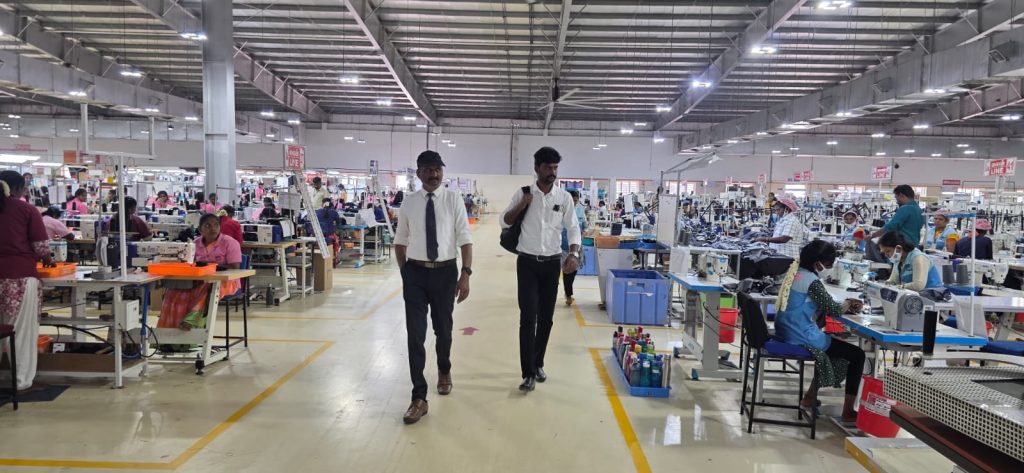
A spinning mill floor is packed with ring frames, draw frames, carding machines, blow rooms, and winding equipment. Without clear floor markings and designated zones, material movement becomes chaotic. Workers spend time searching instead of working. Accidents happen in cluttered spaces.
Multiple Shifts Create Confusion
Spinning mills run day and night. When one shift ends and another begins, the incoming team often has no clear picture of machine status, batch progress, or where tools and materials were left. Without standard visual systems, every shift starts with confusion and delay.
New Workers Cannot Learn Fast Enough
Worker turnover in the textile industry is high. Training new operators takes time — time that mills cannot always afford. A workplace organised with visual tools, colour codes, and clear labels helps new workers understand the correct way of doing things without needing someone to explain everything from scratch.
Yarn Quality Is Very Sensitive
In spinning, small problems cause big quality failures. Contamination, incorrect material handling, and unchecked machine wear affect yarn count, strength, and appearance. These quality issues directly result in order cancellations and damage the mill’s reputation in the export market. 5S implementation in the textile industry creates the clean, organised, and standardised environment that quality depends on.
How 5S Is Implemented in a Spinning Mill — Step by Step
Step 1: Sort — Remove What Is Not Needed
The Sort phase starts with what is called a Red Tag Campaign. Every item on the shop floor is physically tagged and questioned: Is this needed here? How often? In what quantity?
Items that are not needed in the production area are removed. Rarely used items are relocated to a central storage area. Old parts, broken trolleys, excess bobbin cans, outdated records — all of it goes.
In most spinning mills, this single step frees up 15 to 25 percent of floor space. The floor breathes again. Supervisors can see their sections clearly. Movement becomes easier and safer.
Step 2: Set in Order — Organizing Every Item in Its Right Place
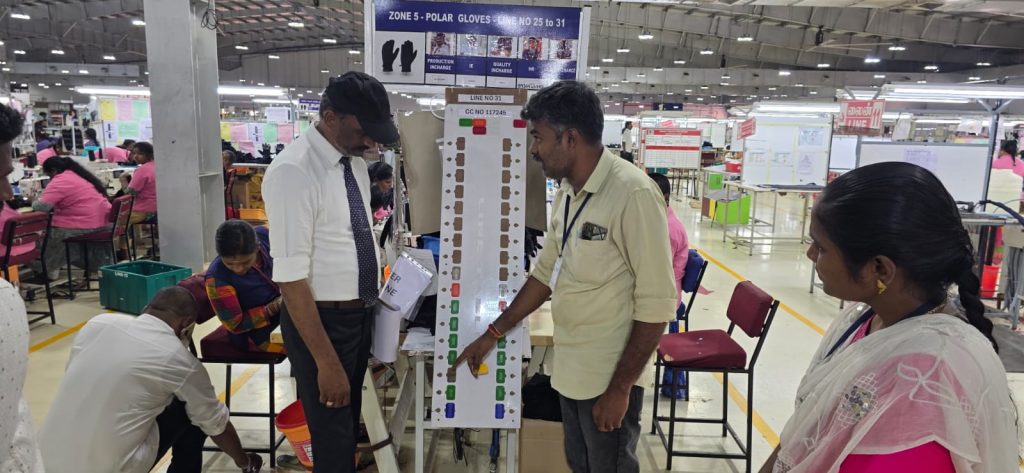
Once unnecessary items are cleared, every remaining item gets a fixed home. In a textile unit, this means bobbin trays are colour-coded by yarn count, maintenance tools go on shadow boards near each machine, movement lanes are marked with floor paint and signs, and machine status is communicated visually with simple tags or indicators.
This step transforms a floor where workers rely on memory into one where the environment itself communicates information. Searching time drops. Errors reduce. New workers orient themselves faster.
Step 3: Shine — Clean to Inspect
In a textile factory, Shine means more than cleanliness. It means machine health. When ring frame operators and carding machine attendants clean their assigned machines as part of a daily routine, they start noticing things they would normally miss — a warm bearing, a blocked suction pipe, an apron showing unusual wear.
This idea is called “clean to inspect.” Operators become the first line of machine maintenance. Problems are caught early, before they become expensive breakdowns. Cleaning schedules are created for every section — Blow Room, Carding, Draw Frame, Simplex, Ring Frame, and Winding — with specific tasks assigned to specific people.
Step 4: Standardize — Make Good Practice Permanent
This step turns temporary improvements into permanent ones. One-Point Lessons, called OPLs, are visual instruction cards posted at each machine. Before-and-after photo boards are displayed in each section. Daily, weekly, and monthly checklists are introduced and signed by operators and supervisors.
5S implementation in the textile industry at this stage becomes visible in every corner of the factory — in the labels, the colours, the boards, and the checklists.
Step 5: Sustain — Build the Culture
Sustain is the most important and most difficult step. Internal 5S Auditors are trained from within the organisation — supervisors and team leaders who conduct regular audits, find gaps, and coach their teams. Monthly audits with scores, departmental competitions, and recognition for top-performing sections keep the standards alive long after the initial implementation.
What Spinning Mills Gain from 5S
The results of proper 5S implementation in the textile industry are real and measurable:
- Unplanned machine downtime reduces by 10 to 20 percent within the first six months
- Yarn defects and rejections fall due to cleaner machines and standard handling
- Shift changeovers happen faster because everything is in its place
- Worker morale improves because the environment is clean, organised, and safe
- Export buyers and quality auditors arrive to a factory that immediately communicates discipline and competence
- Fire and safety risks drop because floors are clear and machines are regularly inspected
Kaizen: The Natural Next Step After 5S
Once 5S implementation in the textile industry has given your factory a clean and organised foundation, the natural next step is Kaizen — the Japanese practice of continuous small improvements made by the people who do the work every day.
Quality Circles support this further. Small teams of workers meet regularly to discuss problems, study root causes, and propose solutions. Because the ideas come from the workers themselves, the solutions are practical and they last. Together, 5S and Kaizen create a textile mill that improves from within — because its people are empowered, informed, and proud of where they work.
Why Choose WinCube Solutions for 5S Implementation
Many consultants talk about 5S. WinCube Solutions actually lives it — on the factory floor, with your workers, in your language, suited to your culture.
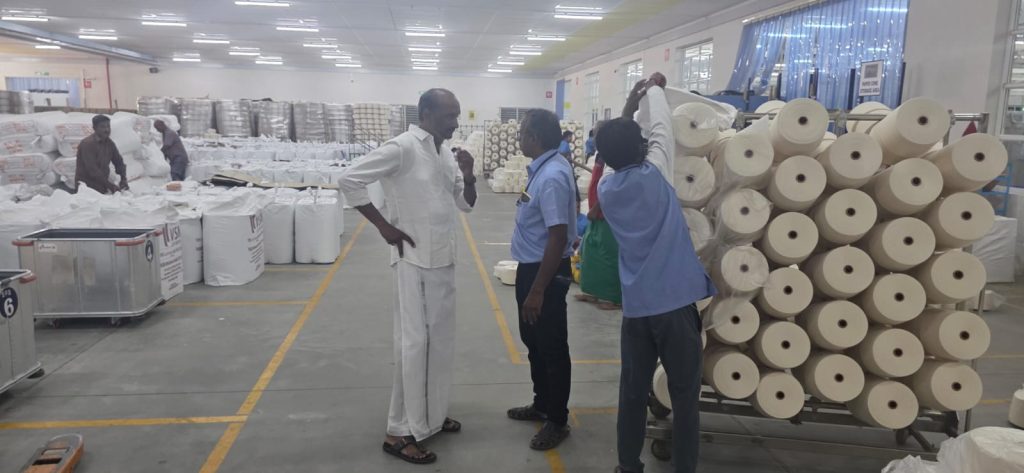
With over 20 years of hands-on experience in spinning divisions, garment units, knitting factories, and dyeing plants across Tamil Nadu, WinCube brings real floor-level knowledge to every engagement. We understand shift pressures, ring frame operations, and what it truly takes to drive 5S implementation in the textile industry that sticks.
Unlike programmes copied from Japanese or Western models, WinCube’s approach is built around Indian workplace culture — the way workers think, communicate, and take pride in their environment.
Our mentoring is fully ethics-driven. We never inflate audit scores or create dependency on our consultancy. Instead, we train your own supervisors and team leaders as certified Internal 5S Auditors, so your factory keeps improving long after we leave.
Clients like Jayalakshmi Textiles and Balavigna Mills have seen measurable results — reduced downtime, better quality, and stronger worker morale — through structured 5S implementation in the textile industry guided by WinCube.
From the first audit to Kaizen and Quality Circle development, WinCube covers your complete journey toward 5S implementation in the textile industry excellence.
Frequently Asked Questions
1. How long does 5S implementation take?
Pilot section: 4–8 weeks. Full factory: 3–6 months.
2. Is 5S suitable for small mills?
Yes, it works for all sizes. Smaller mills often see faster results.
3. Do workers resist initially?
Yes, but involvement and awareness reduce resistance quickly.
4. What is the difference between 5S and 6S?
6S includes Safety as an additional step to improve workplace safety.
5. How to sustain 5S after implementation?
Use audits, checklists, trained teams, and reward systems to maintain standards.
Conclusion
5S implementation in the textile industry is a powerful step toward operational excellence. It goes beyond cleanliness, creating a workplace where machines run efficiently, workers perform confidently, and quality stays consistent. The five steps — Sort, Set in Order, Shine, Standardize, and Sustain — are simple yet highly effective when followed with discipline. Textile mills often see not just process improvements but a positive shift in work culture. With over 20 years of experience, WinCube Solutions supports textile units with practical guidance and deep industry knowledge, helping them build reliable, efficient, and respected workplaces.